
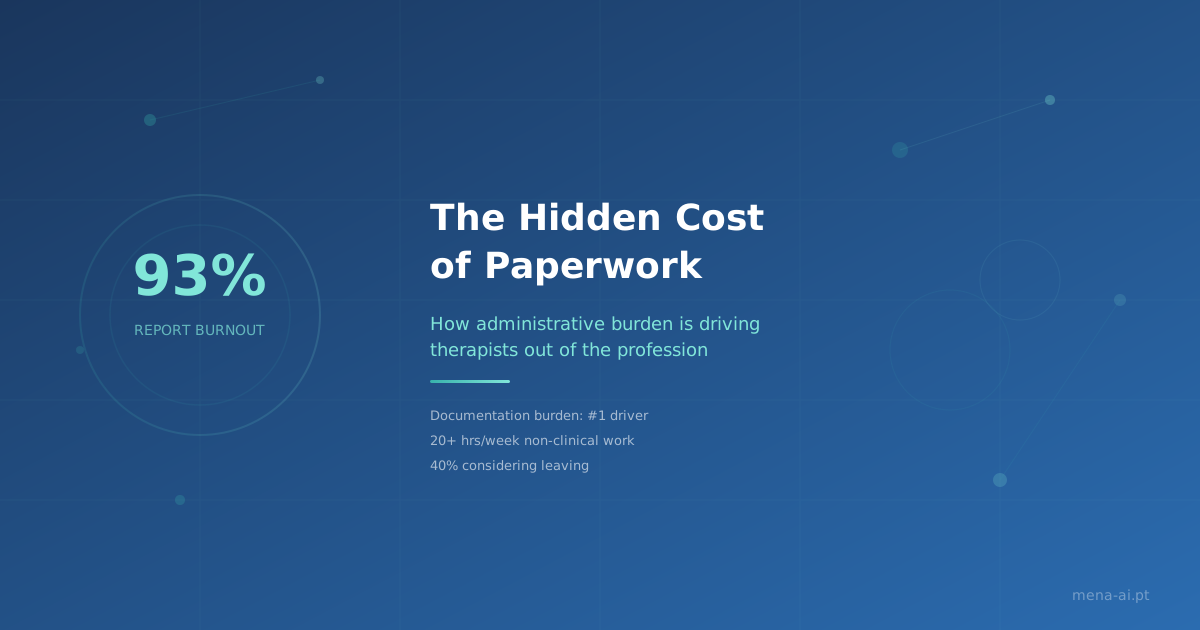
The Hidden Cost of Paperwork: Why Therapists Are Leaving
93% of therapists report burnout, and documentation is the top driver, not compassion fatigue. Here's what the research says and how technology can help.
Most people assume that therapist burnout comes from the emotional toll of the work, sitting with someone's pain, absorbing trauma, navigating crisis after crisis. That assumption is wrong.
The leading driver of therapist burnout in 2025-2026 is administrative burden. Documentation, insurance claims, scheduling logistics, and the accumulated weight of non-clinical tasks are pushing mental health providers out of the profession at a rate we cannot sustain.
This article examines what the latest research tells us about therapist burnout, why it matters for patients, and what evidence-based solutions exist to address it.
The Scale of the Crisis
The numbers are stark. According to a comprehensive behavioral health workforce survey, 93% of behavioral health workers report experiencing burnout, with 62% rating their burnout an 8, 9, or 10 on a 10-point severity scale. Among medical specialties, mental health providers report the highest fatigue at 77%, exceeding even emergency medicine and primary care.
The Tebra Physician Burnout Survey of 219 private practice providers across six specialties confirmed that therapists sit at the top of the burnout rankings. And the SimplePractice Burnout Report found that documentation burden and low compensation are tied as the number one drivers at 23% each, ahead of emotional exhaustion, caseload volume, or lack of support.
This matters because nearly 40% of therapists have seriously considered leaving the profession in the past year. Against a backdrop of 122 million Americans living in Mental Health Professional Shortage Areas and projections of 88,000 counselor vacancies by 2037, every therapist lost to preventable burnout deepens an already severe access crisis.
What Burned-Out Therapists Mean for Patients
Burnout is not just a clinician welfare issue. It directly impacts the people seeking help.
A study published in PMC examining clinician burnout and the effectiveness of guideline-recommended psychotherapies found that patients treated by burned-out therapists achieved clinically meaningful improvement only 28.3% of the time, compared to 36.8% with non-burned-out therapists. That represents roughly a 30% reduction in treatment effectiveness, driven entirely by clinician well-being, not clinical skill.
Research published in March 2026 in Clinical Psychology & Psychotherapy adds another dimension: therapist well-being accounts for 9.4% of the variance in client dropout. When therapists report that they are flourishing, doing well across both personal and professional domains, their clients are measurably more likely to remain in treatment.
With average early dropout rates sitting at approximately 27.8%, this connection between therapist burnout and patient retention represents a significant clinical concern. For a therapist seeing 30 clients, that's 8-9 clients who are statistically more likely to leave treatment prematurely when their provider is struggling.
The relationship appears bidirectional: administrative burden leads to burnout, burnout reduces therapeutic effectiveness, reduced effectiveness increases dropout, and higher dropout further demoralizes clinicians.
The Administrative Tax: What Therapists Actually Spend Their Time On
To understand why documentation is the primary burnout driver, it helps to quantify the non-clinical workload that most therapists carry.
For a therapist with a standard caseload of 20-25 clients per week, the administrative hours break down approximately as follows:
Clinical documentation consumes the most time. Session notes typically require 15-30 minutes per client per session, depending on the complexity of the case and the requirements of the therapist's payer or licensing board. For a 25-client week, that's 6-12 hours of documentation alone.
Insurance and billing adds another 3-5 hours per week for therapists who accept insurance. This includes claims submission, prior authorization, denied claim follow-up, and eligibility verification. Therapists in private practice often handle this themselves.
Scheduling, communication, and coordination accounts for 3-5 hours weekly. Client emails, phone calls, appointment reminders, cancellations, and coordination with other providers all fall into this category.
Treatment planning and outcome review requires 2-3 hours per week for maintaining treatment plans, reviewing clinical scales, and preparing for sessions.
In total, a full-time therapist may spend 15-25 hours per week on non-clinical tasks, approaching or exceeding the time they spend in direct client sessions. For private practice therapists who also manage their own business operations, the figure can be even higher.
Why Traditional Solutions Fall Short
The standard advice for therapist burnout often centers on self-care: set boundaries, take breaks, practice what you preach. While self-care matters, it fails to address the structural problem. As one behavioral health workforce analysis noted, "burnout is hard to address because the administrative work that drives it does not stop while you are trying to recover."
Hiring administrative staff helps but isn't always economically feasible, particularly for solo practitioners. The average therapy session reimburses between $80-150 from insurance, and after overhead, many therapists earn $50-80 per clinical hour. Adding a part-time admin at $20-25/hour requires either raising rates (which can reduce access) or seeing more clients (which increases the caseload that drives burnout).
Practice management software has improved over the past decade, but many platforms still require significant manual input. A therapist might use one system for scheduling, another for billing, and a third for documentation, creating fragmentation that adds to the cognitive load rather than reducing it.
Technology Solutions That Actually Reduce Administrative Burden
Several categories of technology have demonstrated measurable impact on therapist administrative workload.
AI-Assisted Clinical Documentation
The most significant time savings come from AI-powered documentation tools that can generate draft clinical notes from session recordings. With client consent, these tools listen to therapy sessions and produce structured progress notes that the therapist reviews and edits.
The data on time savings is consistent across vendors: 15-20 minutes saved per session. For a therapist seeing 20 clients per week, that translates to 5-7 hours of recovered time, equivalent to 6-8 additional client sessions or a full day of work-life balance.
The critical requirement is HIPAA compliance. Any tool that processes session audio or generates clinical documentation must meet healthcare privacy standards, with data encryption in transit and at rest, business associate agreements, and clear data retention policies. The therapist must also review every AI-generated note before signing, these are tools for drafting, not for autonomous documentation.
Integrated Measurement-Based Care
Digital administration of clinical outcome scales, such as the PHQ-9 for depression and GAD-7 for anxiety, allows therapists to track patient progress between sessions without manual scoring. When these scales are integrated into the EHR and automatically visualized as trends, therapists can identify client deterioration earlier while spending less time on data entry.
Research consistently shows that measurement-based care improves outcomes. When combined with digital delivery, it also reduces the per-session administrative workload of tracking client progress.
Unified Practice Management Platforms
The shift toward all-in-one platforms that combine scheduling, billing, documentation, telehealth, and outcome tracking under a single system reduces the cognitive overhead of switching between tools. Modern platforms can automate appointment reminders, handle insurance eligibility checks, and flag documentation gaps, eliminating several categories of manual work.
At Mena.ai, we've built this integration with a specific focus on the therapist-patient relationship: AI-assisted session analysis that supports clinical decision-making, automated outcome tracking, and practice management tools designed to minimize the time between "session ends" and "documentation complete."
Between-Session Patient Engagement
Tools that allow clients to complete mood tracking, therapeutic exercises, and check-ins between appointments serve a dual purpose: they improve clinical outcomes through continuity of care, and they reduce the therapist's coordination burden by automating the between-session touchpoints that would otherwise require phone calls or emails.
What Clinics and Practices Can Do Now
Beyond technology adoption, several organizational strategies have demonstrated effectiveness in reducing administrative burnout:
Caseload auditing with economic modeling. Some practices have found that reducing caseloads by 15-20% while modestly increasing rates leads to better client retention, fewer no-shows, and improved therapist satisfaction, with minimal revenue impact. The math works because burned-out therapists have higher dropout rates, more cancellations, and ultimately see fewer billable hours despite larger caseloads.
Protected documentation time. Blocking dedicated time for notes and admin, rather than expecting therapists to document between back-to-back sessions, reduces the overlap of emotional labor and administrative tasks. Several group practices have reported that this single change meaningfully reduces clinician reports of feeling overwhelmed.
Note requirement audits. Therapists often write more detailed notes than their payer or licensing board actually requires. A periodic audit of documentation standards can identify opportunities to streamline without compromising clinical or legal requirements.
Peer consultation groups. While not directly an administrative solution, regular peer consultation reduces the isolation that amplifies burnout. Therapists who feel supported by colleagues are more resilient to the stressors that administrative burden creates.
The Path Forward
The mental health workforce crisis is fundamentally a sustainability crisis. We do not lack people who want to become therapists, graduate programs in clinical psychology, counseling, and social work remain competitive. We lack the infrastructure to keep therapists in practice once they arrive.
Every hour spent on documentation that could be automated is an hour unavailable to someone who needs care. Every therapist who leaves the profession due to preventable burnout represents years of training and clinical expertise lost to a system that failed to support them.
The solution requires action at multiple levels: policy changes that address reimbursement rates and administrative requirements, organizational practices that protect clinician well-being, and technology that removes friction from the non-clinical aspects of practice.
The 93% burnout rate is not inevitable. It is the product of systems that can be redesigned. The tools exist. The research supports their effectiveness. What remains is the will to implement them, and the urgency of recognizing that therapist well-being and patient outcomes are not separate concerns. They are the same concern.
The 93% burnout rate is not inevitable. Mena.ai gives therapists their time back with AI-assisted documentation, integrated outcome tracking, and practice management built around the clinician-patient relationship. See how it works →
Frequently Asked Questions
How many hours per week do therapists actually spend on non-clinical work?
For a therapist with a standard caseload of 20-25 clients per week, non-clinical work typically totals 15-25 hours: 6-12 hours of documentation, 3-5 hours of insurance and billing, 3-5 hours of scheduling and communication, plus 2-3 hours of treatment planning. For private-practice therapists managing their own operations, the figure is usually higher.
Does therapist burnout actually affect patient outcomes?
Yes, measurably. A PMC study found that patients treated by burned-out therapists achieved clinically meaningful improvement only 28.3% of the time, compared to 36.8% with non-burned-out therapists — roughly a 30% reduction in effectiveness driven entirely by clinician well-being. Therapist well-being also accounts for 9.4% of the variance in client dropout.
How much time can AI-assisted documentation actually save?
Industry data shows consistent savings of 15-20 minutes per session. For a therapist seeing 20 clients per week, that's 5-7 hours of recovered time — equivalent to a full day of work-life balance or 6-8 additional clinical sessions. The critical requirement is HIPAA compliance and clinician review of every AI-generated note before signing.
Will AI replace therapists?
No. AI works best as infrastructure that supports clinical work — documentation, scheduling, between-session tracking — not as a substitute for the therapeutic relationship. The most promising tools amplify the therapist's capacity rather than competing with it. Clinical formulation, judgment, and the human relationship remain irreplaceable.
References:
- Tebra. (2025). "Physician Burnout Survey: Private Practice Providers." tebra.com
- SimplePractice. (2025). "Therapists Are Burning Out, Here's Why." simplepractice.com
- PMC. (2024). "Clinician Burnout and Effectiveness of Guideline-Recommended Psychotherapies." pmc.ncbi.nlm.nih.gov/articles/PMC11024738
- Clinical Psychology & Psychotherapy. (2026). "Therapists' Well-Being Tied to Client Dropout Rates." Published March 21, 2026.
- HRSA. (2026). "Mental Health Professional Shortage Area Data." data.hrsa.gov
- PIMSY EHR. (2025). "Administrative Friction and Clinician Burnout." pimsyehr.com
- National Council for Mental Wellbeing. (2025). "Behavioral Health Workforce Under Pressure." thenationalcouncil.org
- ClinikEHR. (2026). "AI Clinical Documentation Benchmarks." clinikehr.com
If you are going through a difficult period, do not hesitate to seek support. In the US, you can reach the 988 Suicide & Crisis Lifeline by calling or texting 988 (available 24/7).