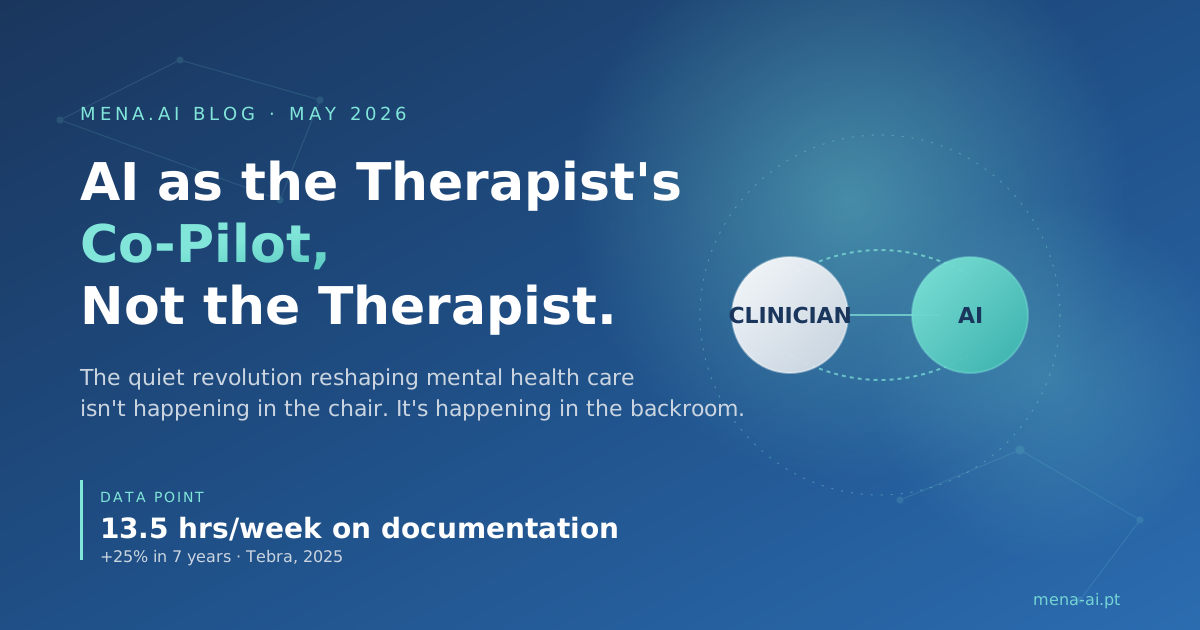
AI as the Therapist's Co-Pilot, Not the Therapist
The AI mental health debate misses the real story. The change is happening in documentation, between-session support, and decision tools quietly reshaping practice.
For most of the last two years, the public conversation about artificial intelligence in mental health has been dominated by a single question: Can AI replace the therapist?
It is a dramatic question, and the headlines it generates are predictably loud. A 2026 study in Nature Medicine showed that a purpose-built clinical AI outperformed the top 10% of human therapists on CBT delivery in 74.3% of sessions. The Dartmouth-led Therabot randomized controlled trial reported a 51% reduction in depression symptoms after eight weeks of use, a result in the ballpark of outpatient therapy. Meanwhile, an analysis from Brown University found that general-purpose chatbots, when prompted to behave as therapists, routinely commit fifteen distinct ethical violations: fake empathy, mishandled crises, increased stigma toward patients with schizophrenia or alcohol dependence.
Both sides of this debate are pointing at real things. And both sides are missing the more important story.
The actual revolution in AI mental health in 2026 is not happening in the therapist's chair. It is happening in the backroom, in the documentation, the between-session support, the decision-support tools. It is quieter. It is less ideologically interesting. And it is, unmistakably, working.
This article is about that quieter revolution: what it looks like, why it matters, and what clinicians and patients should expect from it.
The bottleneck nobody is talking about
To understand why "AI co-pilot" is more important than "AI therapist," start with the actual state of the mental health workforce.
Behavioral health clinicians today spend an average of 13.5 hours a week on documentation, a 25% increase over the past seven years. According to Tebra's 2025 survey of behavioral health professionals, 62% describe their burnout as moderate to severe, and 82% of those affected name administrative work as the primary driver. 23% of clinicians identify documentation specifically as the single biggest contributor to burnout, tied with low compensation. Across the broader behavioral health workforce, 93% report experiencing burnout at some level.
The downstream effects are not abstract. The U.S. Substance Abuse and Mental Health Services Administration (SAMHSA) projects a shortage of approximately 31,000 full-time-equivalent mental health practitioners by 2025. Among current behavioral health workers, 48% say workforce shortages have already pushed them to consider leaving the field.
This is not a problem that can be solved by training more therapists, because the people we train keep leaving. It is a problem that can only be solved by changing the job itself.
What "AI co-pilot" actually means
The "co-pilot" framing borrows, deliberately, from aviation. In a cockpit, the autopilot does not fly the plane, it handles the predictable, repetitive workload that would otherwise fatigue the human pilot, freeing them to focus on judgment, exception handling, and the parts of the job that require expertise.
This is the model that has quietly emerged for AI in clinical mental health practice in 2026. There are roughly four use cases where it is already producing measurable results:
1. AI scribes and documentation tools
The most obvious and immediate application. Recent industry data show AI scribes cutting per-note time from 12–15 minutes to 6–7 minutes. Across a typical day of six sessions, this returns approximately 45 minutes of clinical time. Across a week, it adds up to a recovered evening.
A randomized controlled trial of one such tool (Yung Sidekick) with 70 licensed psychotherapists in the United States found measurable reductions in administrative workload without compromising note quality. A separate 2025 study published in PMC on the use of ambient AI scribes found similar results across general healthcare contexts: reduced burnout, recovered time, and high clinician satisfaction.
The catch, and there is always a catch, is documented in a JMIR Mental Health qualitative study earlier this year, which found that AI-transformed clinical notes still contain meaningful errors. The implication is not "don't use AI scribes." The implication is "AI scribes produce drafts, not finished products. Clinician review remains non-negotiable."
2. AI-enabled clinical decision support
A more subtle use case, and one that is producing some of the most striking early results. A 2026 study published in Frontiers in Digital Health examined the impact of providing UK NHS clinicians with AI-organized pre-assessment information for mental health intakes. The AI was not making clinical decisions. It was organizing patient-reported information into a clinically useful format before the assessment.
The results: clinicians using the tool reported higher wellbeing, higher task performance, and lower cognitive burden. The mechanism is straightforward. Clinical decision-making is exhausting in part because the clinician has to do their own information triage on top of the actual cognitive work of formulation. Removing the triage burden, without removing the decision, frees up the part of the brain that matters.
This is the model worth scaling: AI handles the inputs, the human handles the judgment.
3. Between-session support for patients
This is, arguably, the most important and least-discussed application. There are 168 hours in a week. A therapy patient, in a good week, spends one of them with their therapist. The other 167 hours are where most of the actual change in evidence-based therapy happens, through homework, practice, mood tracking, and the accumulation of small interventions — this is the space where between-session patient support matters most.
The empirical reality is that adherence to between-session work is poor. Most patients do not complete homework consistently. Most do not maintain a mood journal past the third week. Most arrive at the next session with limited recall of what happened in the intervening days.
A 2025 real-world observational study of Wysa Copilot, published in PMC and described in the Stanford HAI overview, found that patients using AI-enabled therapy support tools as adjuncts to human-led therapy demonstrated higher attendance, fewer dropouts, and higher reliable improvement and recovery rates compared to control groups doing standard between-session homework. The AI did not deliver the therapy. It made the homework actually happen.
This is the part of mental health care that has historically had no tooling, and it is the part that arguably matters most.
4. Administrative and operational support
The least glamorous category, and one of the most impactful. Scheduling, billing, and related administrative workflows — intake routing, billing pre-fills, insurance documentation, treatment-plan templating, follow-up reminders. These are tasks that no clinician trained for years to do, and that nonetheless consume an enormous fraction of operational hours in a typical practice.
The 2025 APA practitioner survey found that 29% of practitioners now use AI at least monthly in their practice, and 56% have used it at least once. Adoption is happening, individually and quietly, mostly outside of institutional frameworks.
Why patients should care
If you are a patient, the version of this future that benefits you is not a chatbot pretending to be a therapist. It is the therapist who has 45 minutes more in their day, more energy in your session, and a clearer picture of what you've been struggling with between visits.
It is also, increasingly, the tool that helps you keep your own momentum between sessions, the one that nudges you to log a mood, surfaces a CBT exercise at the right moment, or reminds you to do the breathing practice your therapist suggested. Not therapy. Scaffolding for therapy.
The right question to ask of any AI mental health tool, as a patient, is not "is this as good as a human therapist?" It is "does this help me get more out of the human therapist I already have?"
What clinicians should ask before adopting
For clinicians considering AI tools in their own practice, the relevant questions are largely operational rather than philosophical:
- Where does session data go, and who can access it? This is a HIPAA / GDPR question, not a marketing question. If a vendor cannot give you a clear, specific answer about data residency, processing, and retention, that is the answer.
- Is the AI output editable, and is editing required? Tools that surface a draft and force clinician review are clinically defensible. Tools that auto-publish finished clinical notes are not.
- How is patient consent obtained? A line in intake paperwork is not consent. Patients should be informed in plain language, before each AI-processed session, and should retain a meaningful right to opt out.
- Is the tool purpose-built for clinical contexts? General-purpose chatbots, even good ones, were not built for mental health and do not behave well in it. The Brown University analysis is the relevant evidence.
- Does it integrate with your existing workflow, or replace it? Tools that require clinicians to learn an entirely new operating model rarely survive a busy week.
A note on what AI cannot do
It is worth saying explicitly: nothing in this article should be read as an argument that AI can replace clinical formulation, the therapeutic relationship, or the irreducibly human parts of psychotherapy. The 2025 JMIR qualitative study on psychotherapists' use of generative AI found that clinician trust depends on AI operating in clinician-supervised, supportive roles for low-stakes tasks, and evaporates the moment AI begins to act autonomously in clinical decision-making.
This is the right boundary. AI in mental health works when it expands the therapist's capacity. It fails when it is asked to substitute for it.
What we believe at Mena.ai
We are building, in Portugal, a clinical platform that takes this co-pilot framing seriously. Mena.ai is a complement to therapy, not a replacement: tools for therapists to lighten administrative load, tools for patients to stay engaged between sessions, and a layer of AI-organized clinical information designed to help clinicians spend more of their cognitive energy where it counts.
We are deliberate about what we will not do. We will not build an "AI therapist." We will not auto-publish clinical notes. We will not allow patient data to leave its appropriate clinical context. These are not limitations, they are commitments.
We are working on this with partners we trust: Hospital da Luz, Universidade da Maia, the Ordem dos Psicólogos in Portugal, and the University of Manchester in the UK. The model has been validated in a peer-reviewed publication at ICT4AWE 2025. We are now scaling, carefully, with clinicians who share the view that AI should serve the therapeutic relationship, not displace it.
The takeaway
The defining question of AI in mental health is not whether the AI is as good as the therapist. It is whether the AI gives the therapist back what the system has taken from them, and whether it gives the patient something to hold onto in the long stretch between sessions.
The first version of that future is here, and it is working. It just doesn't make the headlines, because it is not pretending to be a clinician. It is doing what good infrastructure always does: it is quietly making the people who matter more capable of the work that matters.
That is the version of this future worth building.
AI in mental health works when it expands the therapist's capacity. Mena.ai is built around exactly that — clinician-supervised, supportive, validated with partners including Hospital da Luz, Universidade da Maia, the Ordem dos Psicólogos, and the University of Manchester. See how it works →
Frequently Asked Questions
What does an AI co-pilot actually do in clinical practice?
Four main use cases are producing measurable results. AI scribes cut documentation time from 12–15 minutes to 6–7 minutes per session, returning close to 45 minutes of clinical time per day. AI-organized pre-assessment tools reduce the cognitive triage burden before intakes, freeing clinicians for actual formulation. Between-session patient support tools improve attendance and recovery rates by making homework actually happen. And administrative automation — scheduling, billing, treatment-plan templating — removes tasks that no clinician trained years to do but that consume an outsized share of operational hours.
Are AI scribes actually safe and accurate?
With clinician review, yes. The data show 15–20 minutes saved per session without compromising note quality. The catch: a 2026 JMIR Mental Health study found AI-transformed clinical notes still contain meaningful errors. The implication is not "don't use them" — it is that AI scribes produce drafts, not finished products. Clinician review remains non-negotiable. Tools that surface a draft and require sign-off are clinically defensible; tools that auto-publish finished notes are not. The workflow distinction matters as much as the technology.
What should a clinician check before adopting an AI tool?
Five questions worth asking: (1) Where does session data go and who can access it — this is a GDPR/HIPAA question, not a marketing one. (2) Is the AI output editable, and is editing required before it enters the record? (3) How is patient consent obtained — is it active and plain-language, or buried in intake paperwork? (4) Is the tool purpose-built for clinical contexts, or a general chatbot repurposed for healthcare? (5) Does it integrate with your existing workflow or replace it? Tools requiring a full workflow overhaul rarely survive a busy week in practice.
What can AI not do in mental health care?
Clinical formulation, the therapeutic relationship, and the moments of judgment that define good care remain irreducibly human. The 2025 JMIR qualitative study on psychotherapists' use of generative AI found that clinician trust depends on AI operating in supervised, supportive roles for low-stakes tasks — and evaporates the moment AI begins acting autonomously in clinical decision-making. That boundary is not a technical limitation to be engineered around; it is the correct design principle. AI in mental health works when it expands the therapist's capacity. It fails when asked to substitute for it.
References:
- Tebra. Inside the behavioral health burnout crisis (2025). thetebra.com/theintake
- PIMSY EHR. Therapist documentation burnout is a structural problem (2025).
- Frontiers in Digital Health. "AI-driven mental health decision support linked to clinician resilience and preparedness" (2026). frontiersin.org/journals/digital-health
- NEJM AI. Heinz et al. "Randomized Trial of a Generative AI Chatbot for Mental Health Treatment" (2025). ai.nejm.org
- Stanford HAI. A Blueprint for Using AI in Psychotherapy (2026). hai.stanford.edu
- JMIR Mental Health. "Errors in AI-Transformed Patient-Centered Mental Health Documentation Written by Psychiatrists" (2026). mental.jmir.org
- JMIR. "Psychotherapists' Trust, Distrust, and Generative AI Practices in Psychotherapy" (2026). jmir.org
- American Psychological Association. AI reshaping therapy (Monitor on Psychology, March 2026). apa.org/monitor
- SAMHSA workforce projections.
- ICT4AWE 2025, Mena.ai clinical validation paper.
Disclaimer: Mena.ai is a complement to professional therapy, not a substitute. If you are in crisis, please contact local emergency services or a mental health hotline: 988 (US) · Samaritans 116 123 (UK) · SNS 24 (Portugal): 808 24 24 24.