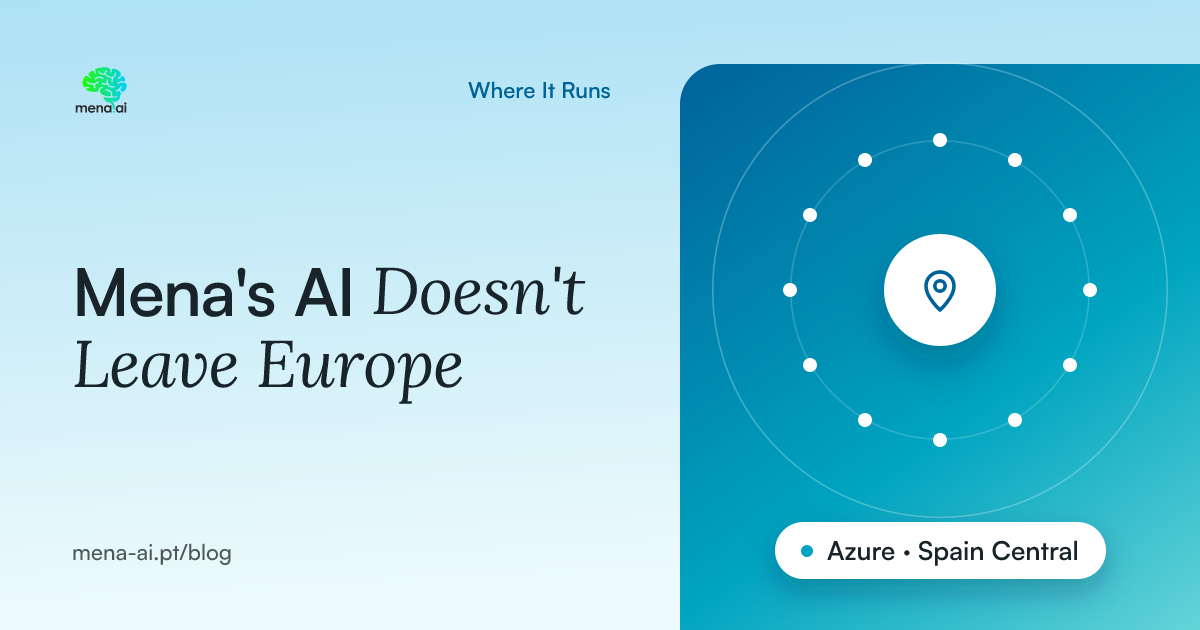
Mena's AI Doesn't Leave Europe: Where It Runs and What It Does With Session Data
- AI in therapy
- GDPR
- data protection
- EU AI Act
- clinical documentation
Where Mena's AI runs, why session audio never goes to an outside AI provider, how patient consent works, and seven questions to ask any clinical AI tool.
In almost every Mena demo, the first question about AI isn't about what it does. It's about where the data goes: "If I record a session, does the audio go to OpenAI?", "Is my patients' data stored in the United States?", "Do you train models on what my patients say?".
These are the right questions. A psychologist is the data controller for their patients' data, and mental health data is among the most sensitive there is. This article answers those questions with the detail of how Mena works today.
The short answer
- The AI models run on our own infrastructure, in Microsoft Azure's Spain Central region, in the European Union. They are open models that we host.
- Audio, transcripts and notes are not sent to outside AI providers. We don't use third-party AI services to transcribe or to draft.
- We don't use clinical data to train or fine-tune models.
- Everything the AI prepares is a draft, labelled as such, that the therapist reviews, corrects or deletes.
- None of this happens without the patient's consent, which they can withdraw at any time.
Why it matters where the AI runs
Most AI tools for health professionals are built on another company's model. The app sends the session audio or text to the model provider, gets the result back and shows it to the user. It is a legitimate architecture, but it has consequences for whoever is responsible for the data:
- One more processor. The model provider now handles your patients' health data and has to be listed in the data processing agreement.
- International transfers. If that provider processes data outside the European Economic Area, there is an international transfer that needs a valid basis under the GDPR.
- Another company's rules. What happens to the data after the request, how long it is kept and who can see it also depends on that provider's terms.
We explain this framework in more depth in our guide to GDPR and artificial intelligence in clinical practice.
Where Mena's AI runs
Mena runs on Microsoft Azure, in the Spain Central region. The application, the database, file storage and the AI models are all in that region.
Session transcription, the summary and the draft notes are produced by open models that we host and run ourselves, on servers with dedicated graphics cards in the same region. A session's audio doesn't leave our infrastructure to be transcribed, and the transcript doesn't leave it to be summarised.
Even the tools we use to measure the quality of the AI's drafts run on our infrastructure rather than on an outside service.
We chose this path because it is the simplest to explain to a psychologist and the easiest to audit. It also means more work for us: running our own models takes more engineering than calling another company's model.
How the data is protected
- One key per clinic. Sensitive personal and clinical fields are encrypted by the application with AES-256-GCM, using a key that belongs to a single clinic. The text the AI prepares about a session is encrypted the same way.
- Encryption at rest and in transit. The database and storage, including recordings, are encrypted at rest. Every connection uses HTTPS.
- No public access. The database and file storage aren't exposed to the internet. Only the application reaches them, over private connections.
- Logged access. Views and exports of patient records are kept in an activity log.
- Two-factor authentication. Any user can turn it on, and the clinic can require it for the whole team.
The details are on our security page.
What the AI does, and what always stays with the therapist
With the patient's consent, Mena's AI transcribes the session, prepares a summary and writes draft clinical notes following the therapist's note template. On the Intelligent plan, the draft can include suggested emotions and cognitive distortions, each with the sentence from the conversation it is based on. They are a vocabulary to help write the note, not a clinical conclusion.
The therapist reviews everything:
- Content prepared by the AI is labelled AI-generated, with a notice that it may contain errors or omissions.
- The session stays pending clinical review until the therapist finishes the review.
- Notes can be edited or deleted, and the transcript can be corrected against the audio.
- Each suggestion can be confirmed or corrected, with a reason. Whatever the therapist corrects leaves the patient's record, and the correction is logged.
The AI doesn't decide anything. The clinical decision always belongs to the therapist.
The Reception Assistant, which helps front desk staff book appointments, has no access to clinical records. It works only with the calendar, and nothing is booked without approval.
We designed the platform around the EU AI Act's transparency and human-oversight duties: AI-generated content is always identified and is meant to be reviewed by a professional. We wrote about what the regulation means for clinical practice in the EU AI Act for psychologists.
Patient consent
Mena splits what the patient authorises into separate consents, and each one is given to a specific therapist:
| Consent | What it allows |
|---|---|
| Session recording | Recording the session, in audio or video, in person or online. |
| Administrative AI assistance | Transcription, the summary and Mena's assistant about the patient. |
| Clinical AI support | Transcription, draft clinical notes and the suggested emotions and distortions. |
Without recording consent, Mena won't let you record. Without AI consent, the recording is stored but not transcribed.
The patient sees the requests in the app and can accept, decline or later withdraw each consent. Declining doesn't affect therapy: it only switches off the features that depend on that consent.
And recording is optional. Many therapists use Mena without recording a single session, writing their notes by hand or on the keyboard.
Model training and research
Your patients' clinical data isn't used to train or fine-tune AI models. The models don't keep what they process.
Research is a separate case and works differently. It can only use a patient's data if they give a dedicated research consent, separate from all the others and entirely voluntary. In that case:
- the transcript is pseudonymised before it leaves the clinical setting: names and other details that identify people and places are replaced;
- data from minors is excluded;
- if the patient withdraws consent, their data used in research is deleted.
What we don't have yet
Mena doesn't hold any security certification such as ISO 27001 or SOC 2 today. We'd rather say so plainly. Our security page describes the controls in place, and our data processing agreement under Article 28 of the GDPR sets out our commitments. It is available to customers and to clinics evaluating Mena.
Seven questions to ask any clinical AI tool
Use this list with Mena or with any other provider:
- Where does the AI model run? In which country and on what infrastructure?
- Is session data sent to another AI company? If so, which one, and is it on the list of processors?
- Is my data used to train or improve models? Is the answer in the contract or only on a web page?
- Is AI-generated content labelled as such?
- Can I review, correct and delete everything the AI prepares?
- Does the patient give separate consents for recording and for AI, and can they withdraw them?
- Is there a data processing agreement under Article 28 of the GDPR?
If any answer is vague, ask for it in writing.
If you'd like to see how Mena answers each one in practice, book a demo.