What's New in Mena: Everything We Shipped This Autumn (2026)
- Mena news
- product updates
- clinic management
- AI for receptionists
- assessment protocols
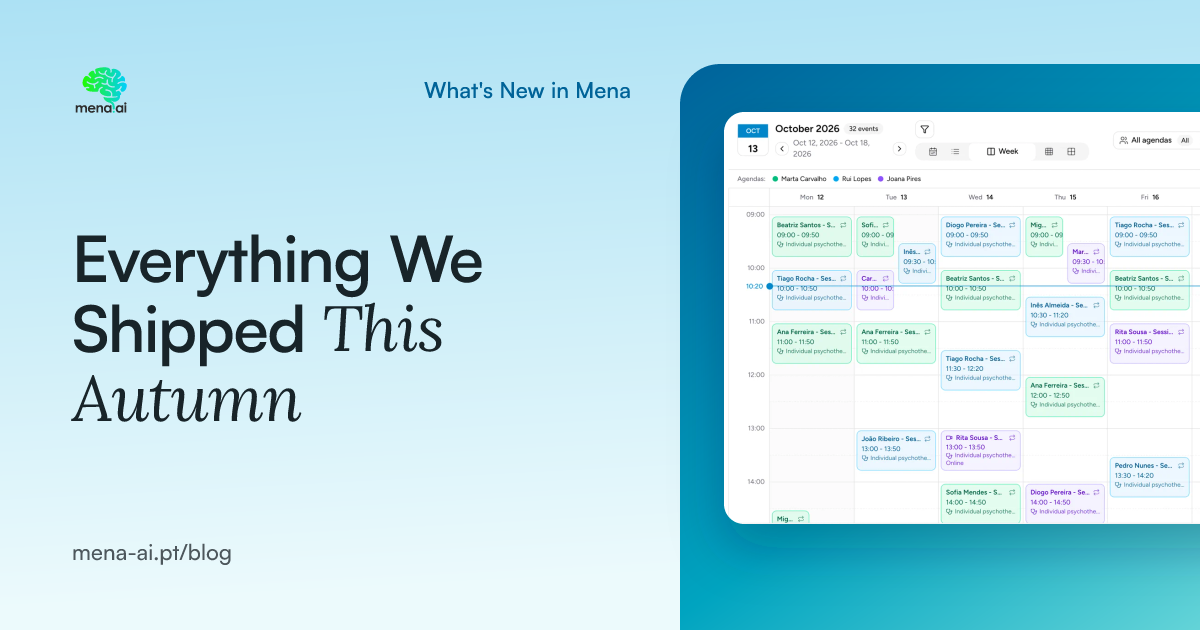
A reception AI assistant, monthly plans and session packs, assessment protocols, rooms, minors and guardians, and more: Mena's product updates from September to November 2026.
In September, the first clinics started using Mena with their whole team: therapists, front desk, clinical coordination and management, all in the same system. Once a tool serves an entire clinic rather than a solo practice, the needs change quickly. The front desk wants to book faster, management wants to know what each therapist is owed at the end of the month, and families want to pay their monthly plan without trading emails.
This article brings together what we shipped between September and November 2026. Almost all of it came out of conversations with the clinics that use Mena every day.
At a glance
- Front desk: an AI assistant that prepares bookings for one-click approval, and a dedicated dashboard for reception staff.
- Clinics with several sites: offices, rooms without double bookings, and indicators per site.
- Billing: monthly plans, session packs, make-up sessions and payment at booking.
- Online booking: a clinic booking page and a widget for the clinic's website.
- Clinical work: assessment protocols, from the questionnaire to the delivered report.
- Minors: guardians with their own accounts and control over what each one sees.
- Consent: requested before the first appointment, using the clinic's own templates.
- Video sessions, team and security: screen sharing, team meetings, commissions and two-factor authentication required by the clinic.
- Spanish, alongside Portuguese and English.
An AI assistant for the front desk
Front desk work is made of short, repeated requests: "book Ana with Tânia next week", "is there a free slot on Thursday afternoon?". The Reception Assistant handles these requests.
You type the request the way you would say it to a colleague. The assistant finds the slot and returns a proposal with the therapist, the date, the time and who will be notified. Nothing is booked until someone clicks Approve. Proposals waiting for approval sit in their own list, so you can approve several in a row at the start of the day.
Two rules have been fixed from day one:
- The assistant has no access to clinical records. It works with the calendar, not with notes.
- It doesn't book, cancel or send anything without approval. The only exception is room assignment, and only if an administrator switches it to automatic mode.
Reception staff also get a front desk dashboard with overdue payments and the next free slots. When a discharge or a dropout opens a slot and there are people on that therapist's waiting list, the front desk is notified so it can fill it.
The Reception Assistant is included in the plans with AI features.
Clinics with several offices and rooms
A clinic with three rooms can't have two appointments in the same room at the same time. You can now register your offices (the addresses) and the rooms in each one in Mena, say which therapists use each room and pick the room for every in-person appointment. Mena won't let two bookings overlap in the same room.
The calendar can be filtered by site and by room, and each person chooses which calendars to see side by side. Home visits and sessions held at schools are labelled as such. In Indicators, management sees figures per site and room occupancy.
Rooms are optional. Until the clinic registers one, nothing changes in the calendar.
Monthly plans, session packs and make-up sessions
Many clinics, especially those that work with children and families, don't charge session by session. They charge a monthly fee. This autumn Mena started handling that model end to end:
- Monthly plans: a fixed amount per month, with one or more sessions a week. Mena books the weekly sessions in the calendar and skips the weeks when the clinic is closed. Payment can be made by bank transfer or with a saved card, charged every month.
- Make-up sessions: when a session covered by the monthly plan is cancelled by the therapist, or by the patient with the required notice, the clinic owes a make-up session. Who cancelled decides the outcome, so the front desk no longer does that maths by hand.
- Session packs: sessions paid in advance, usually at a discount. The clinic keeps the packs it sells most often in a price list. Each appointment uses one credit from the pack when the session takes place. Packs registered after a few sessions can also include those earlier sessions.
Families see their share of the monthly fee and their pending make-up sessions in the app.
Payment at booking and online booking
Two changes cut no-shows and back-and-forth messages:
- Payment at booking. The clinic can request payment as soon as an appointment is booked or confirmed. If the patient doesn't pay in time, the booking is cancelled and the slot is freed. Appointments already covered by a pack or a monthly plan aren't charged again.
- Public booking. Each clinic has a booking page it can share by link or QR code, and a widget to place on its website. The patient chooses the service, the therapist and the time, leaves their details and confirms their email with a code. Each therapist decides in their profile whether to accept online bookings.
Assessment protocols
A psychological assessment is rarely a single questionnaire. It is a battery, with scoring and a report that goes through several hands before it reaches the family. Assessment protocols organise that work:
- Clinical coordination creates the protocol template, with the questionnaires, the interviews and the report stages.
- The therapist applies it to a patient. They fill in the instruments that are theirs to complete and send the patient's ones to the app.
- Questionnaires that have scoring rules are scored by Mena when they are answered, and the therapist can correct any score.
- The report moves through stages such as drafting, review and delivery. Each stage creates a task, with a due date, for the next person responsible.
- At the end, the PDF report can be shared in the patient's app or sent by email.
If you'd like to know more about the instruments themselves, we wrote about outcome assessment in psychotherapy.
Minors and guardians
With children and teenagers, the person who books and pays is almost always a guardian. Registering a minor now requires at least one guardian, up to four. Each guardian has their own account in the app, from which they manage the dependant's appointments, payments and consents.
Each guardian's access to clinical data is switched off by default. You turn it on only for those who should see clinical information. Parents can also create their own account and add their children. Guardians who sign up on their own are labelled unverified, so the clinic knows that link hasn't been confirmed by them yet.
For the wider picture on consent, see our guide to digital informed consent.
Consent before the first appointment
Before the first appointment, Mena asks the patient for the clinic's informed consent and for consent to record sessions. Each clinic can edit its own consent templates.
Recording now has a single consent that covers audio and video, in person and online. If the required consent is missing, Mena won't let you start recording and shows that consent is pending. Recording remains optional: Mena works without recording a single session.
Video sessions, team and security
- Video sessions: screen sharing (on phones too), background blur for the patient, choice of microphone, camera and speakers, and session notes written without leaving the call.
- Team meetings: meetings inside Mena, with video, supervision meetings, and decisions turned into tasks.
- Commissions: the clinic sets how much of each session goes to the therapist, at clinic, service and therapist level. Mena calculates each therapist's monthly statement and emails it when the month is closed.
- Two-factor authentication: the clinic can now require it for the whole team.
Now in Spanish too
The platform, the patient app and the booking widget are available in Spanish, alongside Portuguese and English. It is our first step towards working with clinics in Spain.
What comes next
We keep building with the clinics that use Mena every day. If a feature is missing for you, tell us: many of the ones in this article started that way.
If you'd like to see any of these features in your clinic, book a demo.